Renovation of "Estadio Santiago Bernabéu", Madrid
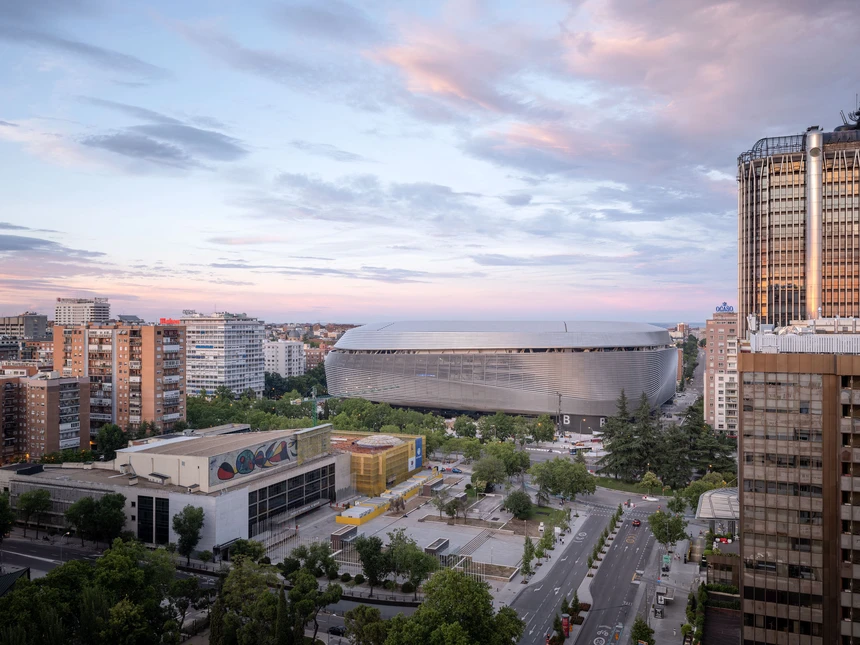
The comprehensive renovation of the Estadio Santiago Bernabéu, the home of Real Madrid, is transforming a legendary sports venue dating back to 1947 into a modern, multifunctional stadium—featuring a new stainless-steel façade and a highly complex retractable roof, as well as structural and functional improvements to the interior. These include expanding the seating capacity to approximately 82,000 seats, a retractable turf field, a 360-degree video screen surrounding the stadium, and new food and beverage and service areas. The structural framework and the roof are central structural and climatic elements of the design.
Transsolar supported the planning team during the early conceptual phase with climate- and comfort-related analyses. The starting point was an evaluation of local climate data to assess the site-specific conditions in summer and winter. Building on this, the influence of the new roof structure on daylight conditions, ventilation, solar radiation, and thermal conditions within the stadium was examined.
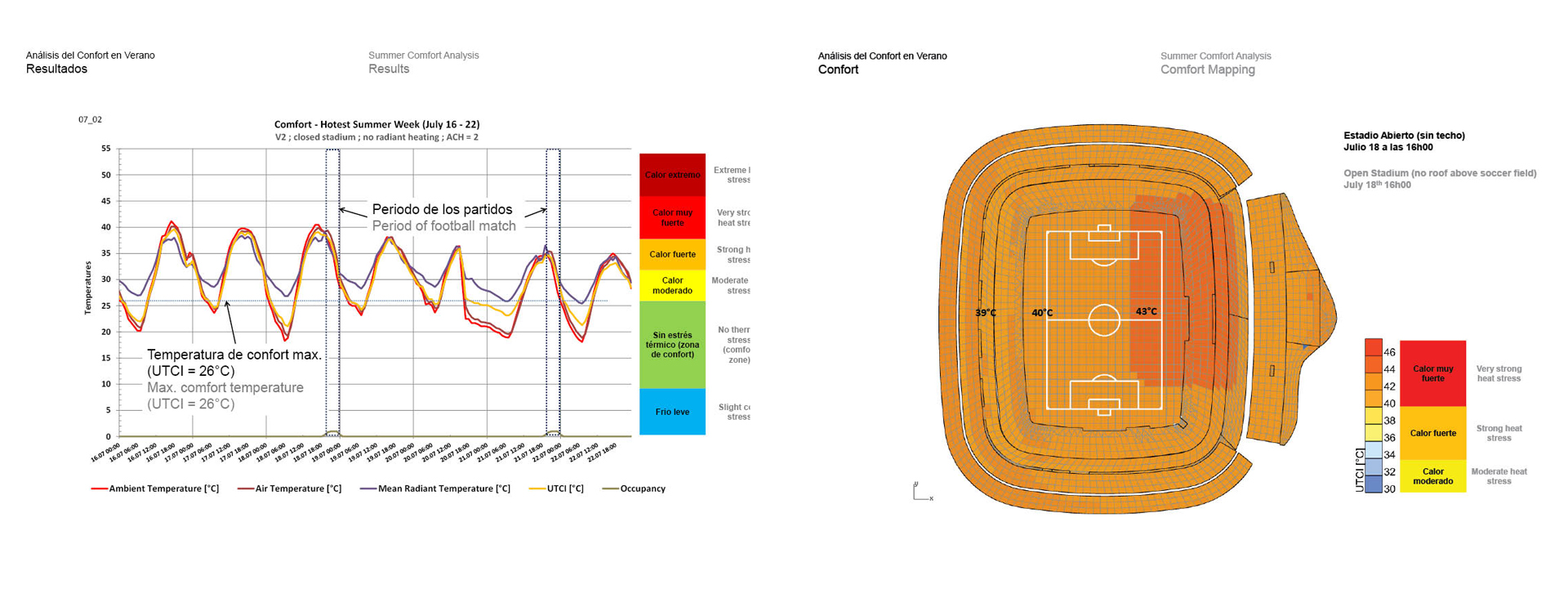
Thermal simulations were used to evaluate spectator comfort in critical summer and winter scenarios. Both situations with the roof open and closed were considered. Particular emphasis was placed on the interplay between roof opening, solar gain, and air exchange within the stadium space. Additionally, for winter conditions, the effect of local comfort measures such as radiant heating was analyzed.
To validate the wind and airflow conditions within the stadium, flow simulations using CFD models were employed . In particular, the study examined how the retractable roof affects ventilation and thermal comfort in the spectator area. The simulations show that closing the roof in winter can significantly reduce cold wind flows and the associated drafts. In summer, however, sufficient natural ventilation can be achieved with the roof open, which contributes to a comparatively even temperature distribution without heat buildup inside the stadium.
The project illustrates how climate-related simulations for highly complex large-scale structures can help coordinate architectural, structural, and usage-related requirements at an early stage. Transsolar’s work thus provided a solid foundation for design decisions at the intersection of comfort, climate, and functionality.