Hitachi Columbus Campus, Mannheim, Germany
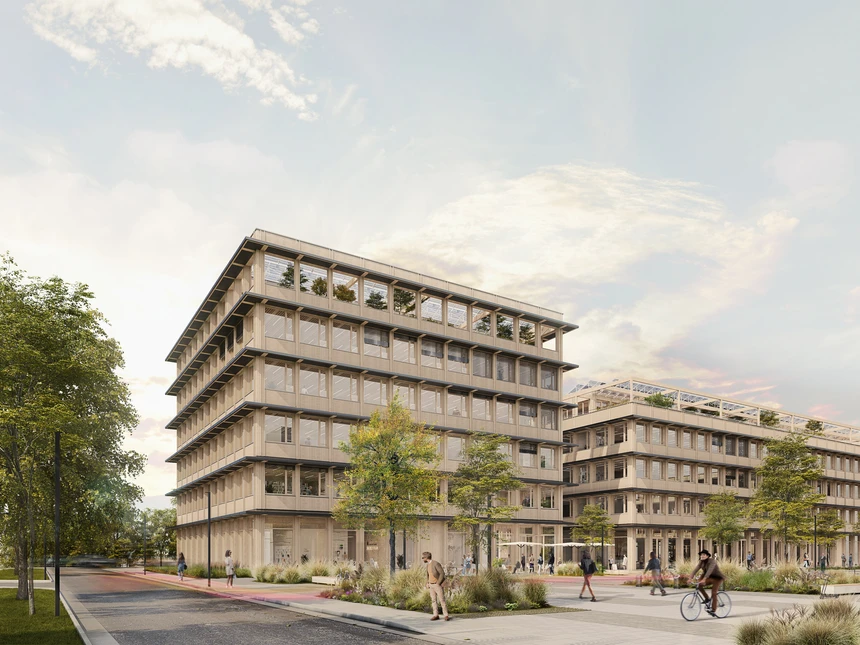
On the former Benjamin Franklin Village barracks site in Mannheim, the Columbus Campus is emerging as a flagship project and landmark. Four buildings are arranged around a central, open plaza. Transsolar developed the holistic climate and energy concept for Buildings A and B. The client defined the goal clearly: climate neutral building operation (meaning that the amount of energy generated on-site matches the building’s operational demand) and, in addition, a long term CO₂ offset of the embodied carbon of the construction. Particularly challenging is the mix of office spaces and energy intensive laboratory and testing areas in Building A. Their heating, electricity, and cooling demands were calculated in detail from the very beginning to ensure that the target values are not merely theoretical but reliably achievable in operation.
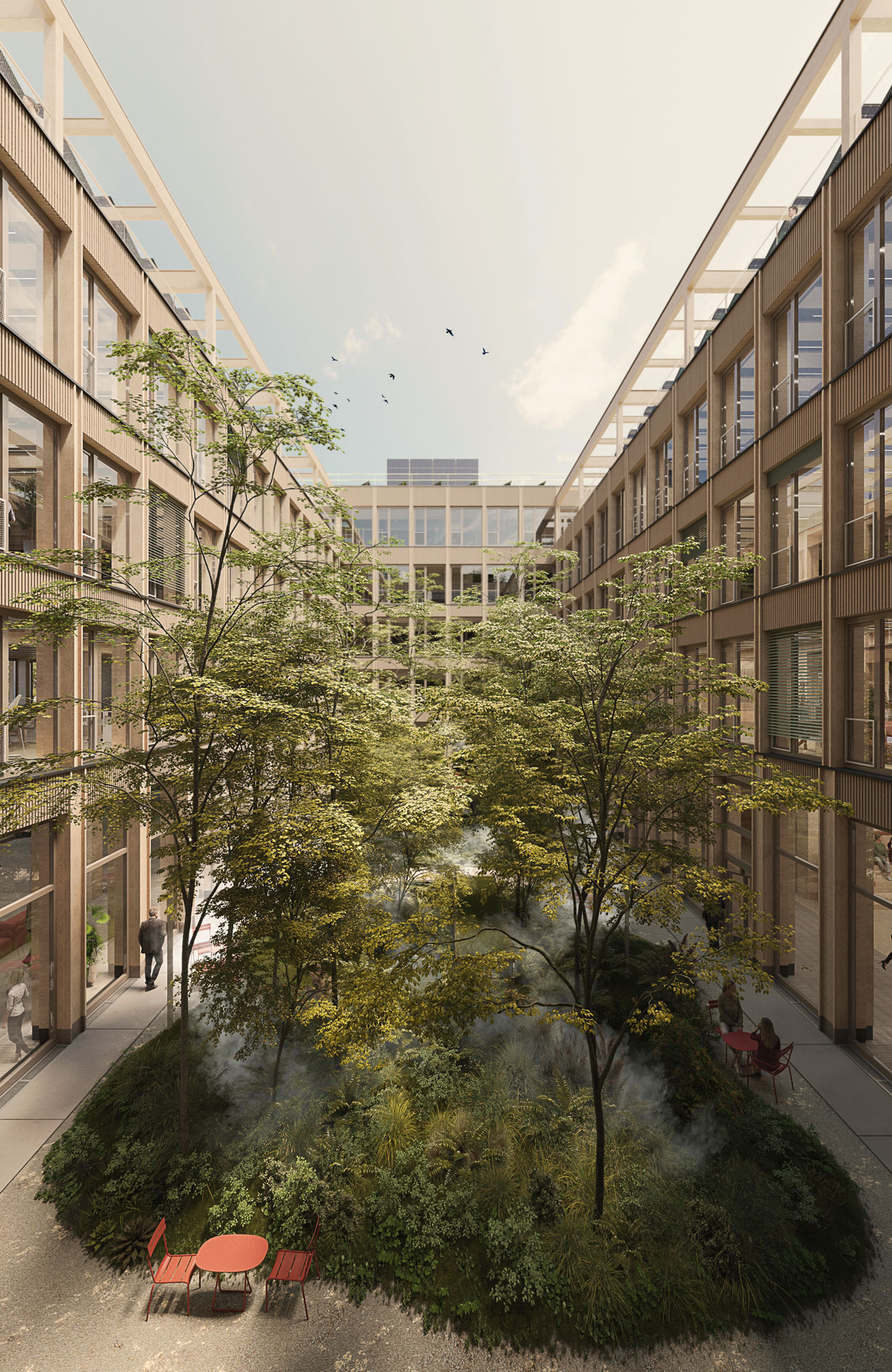
The architecture itself functions as part of the climate strategy. The courtyard enables two sided daylighting and, together with shallow floor depths, provides options for natural ventilation paths. The above-ground structure is designed as a timber structural system, significantly reducing embodied carbon compared to concrete, while the basement is deliberately designed to be as lean and material-efficient as possible. Materials are also used thoughtfully in the details: the floor assembly incorporates excavated sand and concrete pavers as ballast and for acoustic decoupling. These decisions result in a noticeable CO₂ reduction even before the building is put into operation.
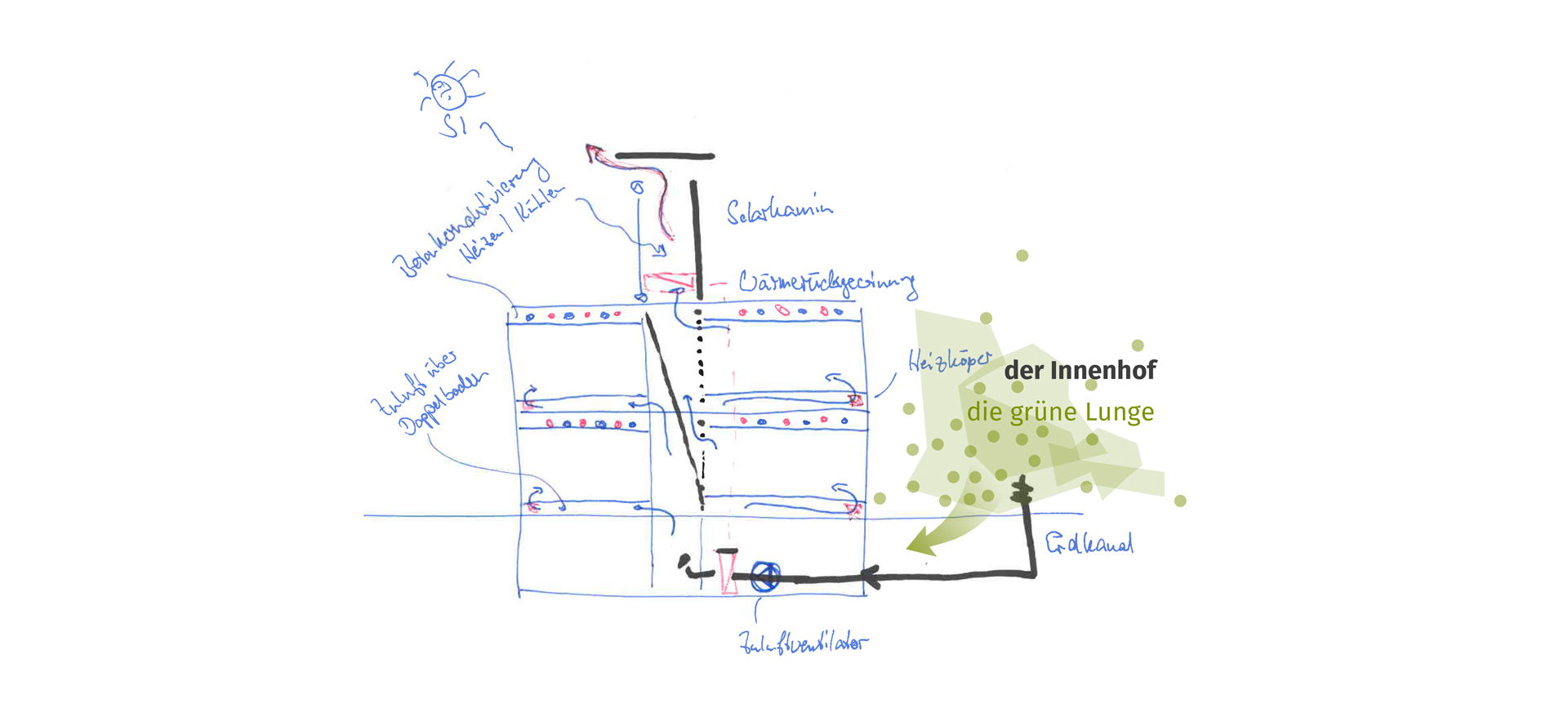
The climate concept combines low loads, high efficiency, and local resources. Earth ducts precondition the supply air, while exhaust chimneys remove it. A closed-loop system provides heat recovery. Heating and cooling sails use groundwater in summer and a heat pump in winter; district heating supplies domestic hot water for the kitchen. The building envelope relies on balanced window areas, solar shading, and photovoltaics.
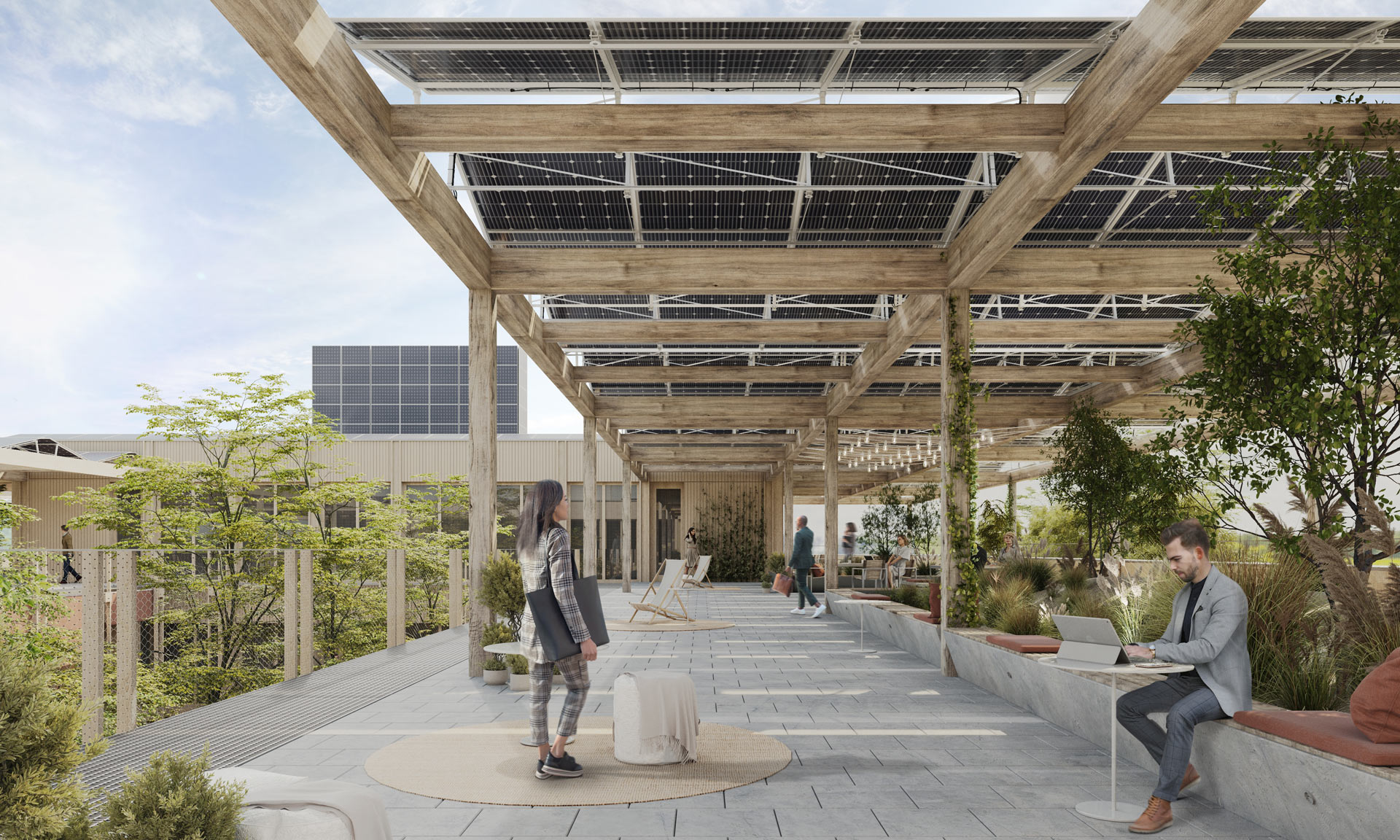
Energy generation is central to the design: photovoltaic surfaces on the eaves and an energy producing pergola provide shade and high quality outdoor space. The green roof area serves as an outdoor workspace and improves the energy balance.
The impact of these measures can be described precisely. For Building A, the CO₂ emissions caused by construction amount to 1,860 tonnes. Thanks to system efficiency, the free cooling potential of groundwater, and the use of renewable electricity, the building achieves a negative CO₂ balance in operation – despite the intensive laboratory and testing uses. More CO₂ emissions are avoided through renewable energy generation than are caused by energy consumption, amounting to approximately 61 tonnes of CO₂ per year. This results in a static payback period of around 31 years for the emissions generated during construction. An ambitious goal thus becomes a robust, verifiable outcome.
The project meets the QNG Premium Standard through comprehensive CO₂ balance optimization and innovative energy concepts. A DGNB Platinum certification is being pursued and has been taken into account in both the planning and execution phases.
2025 Local-Green-Deal-Plakette Stadt Mannheim